
How to Choose a Saree for Your Body Type
A body-positive guide to fabric behaviour, scale, borders, pleats, pallus and blouse proportions—with experiments instead of restrictions.
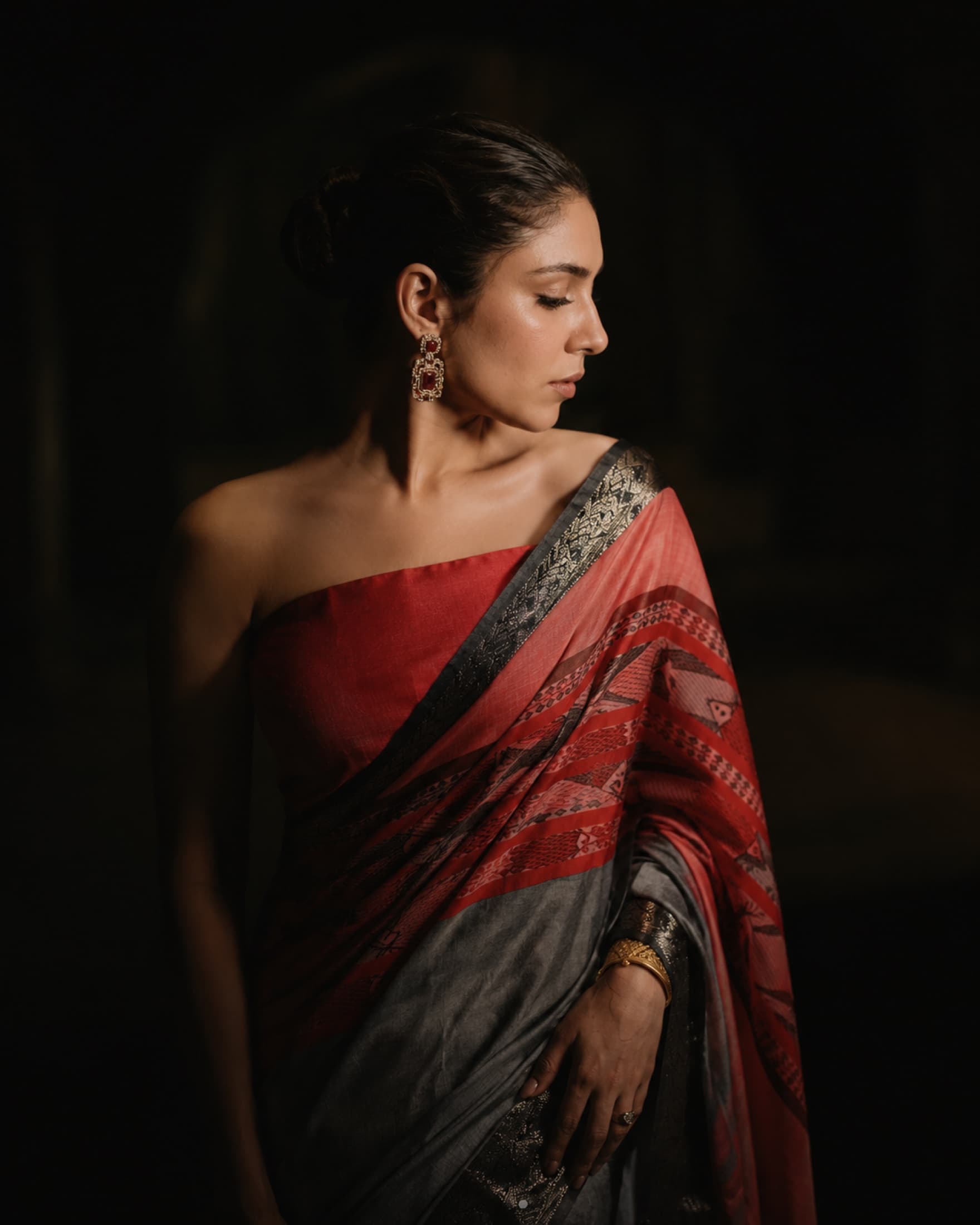
Your body is not a problem to solve
Searches for how to choose a saree for your body type often lead to strict lists: one fabric for a petite frame, another for a curvy frame, and several things each person is told to avoid. A saree is far more adaptable than those rules suggest. The textile, border, pleats, pallu and blouse all change the final silhouette—and each can be adjusted to express a different preference.
A more useful question is not, ‘What am I allowed to wear?’ but, ‘What effect would I like to create?’ You may want a long uninterrupted line, strong structure, generous volume, a defined waist or an easy fluid drape. This guide turns those intentions into practical choices you can test in front of a mirror.
Fabric characteristics vary across traditions. If those names are still unfamiliar, read our introduction to the types of sarees in India before comparing their drape.
Starting points, not body-type rules
Each row offers two different visual directions. Neither is the correct one. Choose the effect that interests you, try it with the actual saree and keep it only if it feels comfortable.
| Starting point | For a continuous line | For more contrast or volume |
|---|---|---|
| Petite or shorter | Precisely set the hem, reduce excess fabric at the waist and test a narrow or tonal border. | Try a defined border, a compact open pallu or one deliberate area of volume. |
| Tall | Use a tonal palette, finer border or long open pallu to emphasise vertical flow. | Explore broad borders, larger motifs and colour breaks across the blouse and saree. |
| Curvy or fuller | Try fluid fall, an uncluttered waist and a pallu that travels cleanly across the torso. | Use structured pleats, a visible border or a more architectural pallu treatment. |
| Straight or athletic | Choose narrow pleats, a controlled pallu and restrained contrast for a clean outline. | Build dimension with texture, pleat volume, a contrasting blouse or a fuller pallu. |
01
Begin with fabric behaviour
Fluidity, body and weight / The foundation of the silhouette
Fabric behaviour has more influence on the final line than a body-type label. A fluid textile tends to follow the body's contours and form narrow folds. A fabric with more body stands away from the figure, holds sharper pleats and creates visible volume. Neither effect is inherently more flattering; they simply produce different silhouettes.
Before deciding, drape a section at the shoulder and gather some of the fabric at the waist. Notice whether it falls, springs back or needs firm handling. Also consider the event: the fabric should remain comfortable through its full duration, not only look successful in a still photograph.
Try this
- Compare one fluid and one structured saree in the same drape.
- Sit and walk before deciding whether the fabric feels manageable.
- Check transparency and weight in daylight as well as indoor light.
02
Choose the scale of the surface
Motifs, checks and negative space / Quiet continuity or visual rhythm
Motif scale changes where the eye pauses. Fine repeats and low contrast can make the saree read as one continuous field. Larger motifs, checks or strong colour relationships create rhythm and make the textile more present. This is a matter of visual emphasis, not a rule tied to height or size.
Consider the saree at conversational distance, not only close up. A detail that looks prominent in the hand may become subtle when draped, while an all-over pattern may gain much more energy once the pleats overlap.
Try this
- Photograph the saree from two metres away to assess its overall scale.
- Compare the motif where it lies flat and where it gathers into pleats.
- Let either the surface or the accessories lead, rather than asking both to compete.
03
Use borders as visual lines
Width, contrast and placement / Continuity, framing or emphasis
A border is a line that travels around the body. A narrow or tonal border tends to merge into the saree, while a broad or contrasting border creates a stronger frame at the hem and pallu. The choice can emphasise vertical length, introduce a deliberate break or bring attention to the movement of the drape.
Placement matters as much as width. Set the hem only after putting on the footwear you intend to wear. Then look at where the upper border crosses the torso and shoulder; a small change in pallu length can shift the balance of the complete composition.
Try this
- Pin the pallu at two different lengths and photograph both versions.
- Try the planned footwear before fixing the hem.
- Compare a tonal blouse with a contrasting one to see how the border reads.
04
Adjust the pleats, not your body
Number, width and placement / Controlled structure or generous volume
Pleats are adjustable architecture. Narrow, evenly stacked pleats can create a precise central line. Wider or fewer pleats make each fold more visible and may give the lower half greater volume. The best arrangement depends on the fabric's thickness, the saree's design and how freely you need to move.
Avoid forcing a thick textile into the same number of pleats you use for a very fine one. Distribute bulk with intention and keep the tuck secure without making the waist uncomfortable. A professional draper can help for complex textiles, but the principle remains the same: work with the cloth you have.
Try this
- Test two pleat widths before completing the full drape.
- Move the pleat group slightly left or right and observe the line.
- Walk, sit and climb a step to confirm that the pleats remain secure.
05
Decide what the pallu should do
Open, pleated, long or compact / Movement, coverage or definition
An open pallu displays more of the textile and creates a broad diagonal across the body. A pleated pallu concentrates the fabric at the shoulder, revealing more of the blouse and giving the outline greater definition. Length changes the mood again: a longer pallu feels fluid and dramatic, while a compact one is easier to manage.
Choose according to movement and comfort as well as appearance. If you will be greeting people, presenting, dining or dancing, decide how much fabric you want to manage. Pins can support the drape, but they should not remove all of its natural movement.
Try this
- Compare an open pallu with a five- or six-pleat version.
- Secure only the shoulder, then add a second pin only if movement requires it.
- Check the pallu from the back as well as the front.
06
Treat the blouse as part of the composition
Fit, length, neckline and contrast / Balance around the face and torso
The blouse changes the proportion of a saree more quickly than most accessories. Sleeve length, neckline, hem and contrast affect how much of the upper body reads as one field. A close colour relationship can create continuity; a contrasting blouse makes a distinct focal block.
Fit comes before theory. The armhole should allow movement, the band should remain secure and the neckline should feel comfortable from every angle. Decide the blouse early enough to test it with the actual saree, undergarments, jewellery and pallu treatment.
Try this
- Try one tonal and one contrasting blouse with the same saree.
- Raise your arms, sit and turn before approving the final fit.
- Photograph the complete neckline with the jewellery you plan to wear.
A better mirror test
Once the complete look is ready, stop asking whether it makes you appear taller, smaller or slimmer unless that is genuinely your goal. Ask whether the proportions feel intentional, whether you can move naturally and whether the saree still looks like your choice.
- Look from a distance. Read the complete silhouette before examining details.
- Test movement. Walk, sit and use the stairs in the planned footwear.
- Change one variable. Adjust the pallu, blouse contrast or pleats—not everything at once.
- Keep the version that feels like you. Confidence comes from recognition, not compliance.
If the occasion itself is the larger question, continue with our guide on how to choose a saree for every occasion.
Find your own line
Choose the saree first. Shape the drape around you.
Explore ANURRAKTI's current one-of-one sarees, then consider the fabric, border and pallu as parts of your own composition.
Explore collectionsSources and further reading
Body-shape categories are broad descriptions, not standards or restrictions. This guide combines established draping considerations with ANURRAKTI editorial advice; the wearer's comfort, preferences and cultural context should lead every choice.
Continue reading
Related saree guides
The Saree Guide / 02
How to Choose a Saree for Every Occasion
A practical framework for choosing a saree for weddings, receptions, festivals, formal events and intimate celebrations.
The Saree Guide / 01
Types of Sarees in India: 8 Regional Traditions
An introduction to eight regional saree traditions, from Banarasi brocade and Kanjeevaram silk to Bandhani resist dyeing and Patola double ikat.
The Saree Guide / 08
Saree Colour Combinations: A Practical Styling Guide
Six reliable ways to combine a saree, border, pallu and blouse using colour relationship, contrast and proportion.